
Reviewed · BATH DAY TRIPS
Best of Bath Walking Tours – Georgian Tour
Bath is one of those cities where the buildings actually explain the story, if you know what to look for. This Georgian Bath walking tour is interesting because it links the architecture to the people who paid for it, walked its streets, and wrote its legends. I like that it is a small group with a guide who keeps you moving, so you do not waste time figuring out where to go next. One drawback to plan for: a few of the top indoor sights along the route charge entry separately, so you will want to decide in advance what you do and do not buy.
My favorite part is the way Bob tells the story while you are walking. You get smart, practical context at each stop, and you can ask questions as you go, which helps the city stick in your mind. The pace feels comfortable, and if you are the type who hates being overloaded with facts, this tour hits a sweet spot: plenty to learn, not so much that you feel like you are in class.
Key Highlights You’ll Care About
- A focused Georgian route that connects Queen Square, the Circus, and the Royal Crescent into one readable walk
- Bob as your guide with humor, sharp city knowledge, and lots of time for questions
- Well-chosen exterior stops so you keep momentum even when indoor tickets are optional
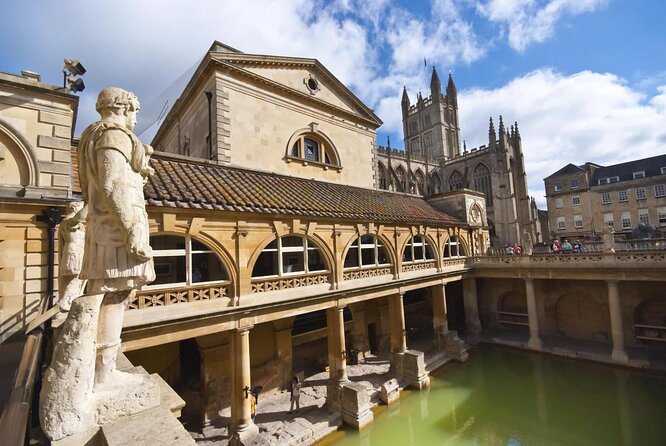
- Roman to Georgian layers at street level, from Bath Abbey’s medieval roots to the Roman Baths
- Pulteney Bridge and Bath Guildhall Market for that lived-in Bath feeling, not just postcard views
- Max 15 people for a tour that stays personal without feeling crowded
Why a Georgian Bath Walking Tour Makes Sense on a Time Budget
If you only have a half-day in Bath, self-guided wandering can turn into a blur of pretty façades. A guided walk fixes that by giving you a simple framework: who built what, why it looked like that, and what it meant in daily life. That is the real value here. You are not just collecting photos, you are learning how the city was designed to impress.
This tour also works because it stays in the heart of Bath, around the best-known Georgian set pieces. You do not need to keep checking maps or constantly asking directions. You just follow Bob and let the architecture teach you.
More Bath day trips:
- Walking Tour of Bath with Blue Badge Tourist Guide
★ 5.0 · 1,877 reviews - Bath: City Walking Tour with Optional Roman Baths Entry
★ 4.7 · 1,401 reviews - Bath: Guided Walking Tour
★ 4.9 · 1,198 reviews
Start at Abbey Churchyard, Where Bath’s Timeline Begins
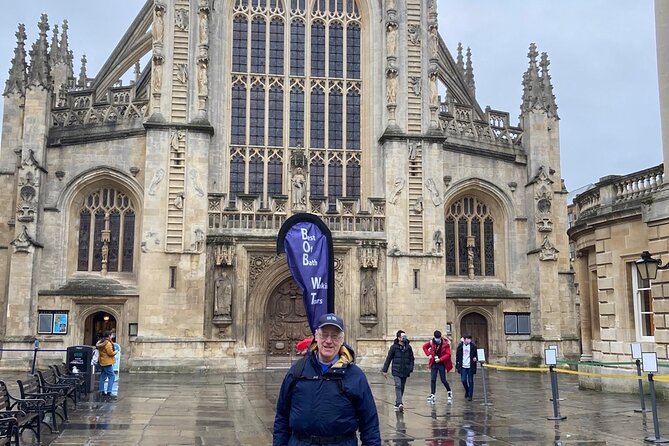
You meet in Abbey Churchyard, right in front of Bath Abbey, Saint Peter and Saint Paul. It is a great starting point because Bath Abbey anchors the whole story, long before the Georgian era puts on its fancy clothes.
Bath Abbey is an Anglican parish church, but it also has older roots as a former Benedictine monastery. The church traces back to the 7th century, then got reorganized in the 10th century, and was rebuilt in later centuries, including the 12th and 16th. Standing here first matters, because once you see where Bath’s religious and civic life began, the later Georgian developments make more sense.
You can expect a short, useful intro to what you are about to see. Then you start walking, with Bob pointing out details so you do not lose the thread when the streets open up.
Bath Abbey Area to the Roman Baths: Learning to See the Layers
After you leave the abbey area, Bob leads you toward the part of Bath that made all this possible: the geothermal springs and the city built around them. The route includes stops and viewpoints around Bath’s hot springs area and the Old City Wall, with enough context to understand why Bath kept evolving in the same spot.
When you reach the Roman Baths, you are stepping into one of the most intact “then and now” experiences in England. These are well-preserved thermae, meaning the Romans built a full bathing complex, not just a quick soak. A temple was constructed on the site between 60 and 70 AD, early in Roman Britain, and later the Roman baths fell into ruin, as noted in the Anglo-Saxon Chronicle about a century afterward. The surrounding area was redeveloped multiple times through the Early and Late Middle Ages, which is why the site feels layered instead of frozen in time.
Important practical note: Roman Baths entry is not included, so if you want to go inside, plan for that cost and time. If you just want the outdoor context and quick orientation, you still get the story, but you will not see the full interior exhibits.
Royal Mineral Water Hospital: Healing Belief Meets Georgian Ambition
One of the best moments on this walk is when you shift from the Romans and medieval layers into Georgian confidence. You pass the Royal Mineral Water Hospital area, a key part of Bath’s self-image as a health destination.
Construction began in 1737, and this is where Bath’s mineral waters get tied to a new mix of faith and early scientific thinking. This stop is short, but it adds meaning to everything else. Bath was not only about beauty and architecture. It was also about how people expected to feel after a course of treatment.
Admission here is also not included, so again, you choose how much indoor time you want. Either way, Bob’s framing helps you understand why Bath invested in institutions that made the springs feel like a system, not a lucky accident.
More walking tours in Bath:
- Roman Baths and Bath City Walking Tour
★ 4.5 · 762 reviews - Bath: Bridgerton Filming Locations Walking Tour with Music
★ 4.7 · 416 reviews - Bad of Bath fun Walking Tour of Bath
★ 5.0 · 402 reviews - Bath: Guided City Walking Tour with Entry To The Roman Baths
★ 4.8 · 343 reviews
Queen Square and Assembly Rooms: Georgian Fashion in Stone
As you move into the Georgian “wow” zone, Queen Square is one of the first pieces in the architectural sequence that leads to the Circus and the Royal Crescent. The square is made up of Georgian houses, and every building is Grade I listed. That sounds technical, but on the street it means you are looking at protected, high-value architecture, designed to create an immediate sense of order and prestige.
From Queen Square, you head toward the Assembly Rooms, which is where Bath’s social engine turns on. In the Georgian era, Bath became fashionable, and the architect John Wood the Elder and his son helped lay out housing for residents and visitors. Assembly Rooms were built early in the 18th century, and later a new venue for balls, concerts, and even gambling was planned between Queen Square, the Circus, and the Royal Crescent.
The upper rooms opened with a grand ball in 1771, and they became the hub of fashionable society. Bob will connect these facts to what you see around you, so it is not just dates. It helps you imagine the crowd moving through the spaces and why the surrounding architecture was part of the performance.
This is another stop where entry is not included, so you may see the exterior and get the story. If you want inside time, check entry options and budget accordingly.
The Circus and Royal Crescent: When Architecture Shows Off
The Circus is the Georgian showpiece that makes you pause. It is a ring of townhouses, designed by John Wood the Elder, built between 1754 and 1768. The key detail is the three-entrance layout. Each segment of the façades faces one of the entrances, so you get a classical-looking view straight ahead from multiple directions. That is why it feels symmetrical and theatrical at the same time.
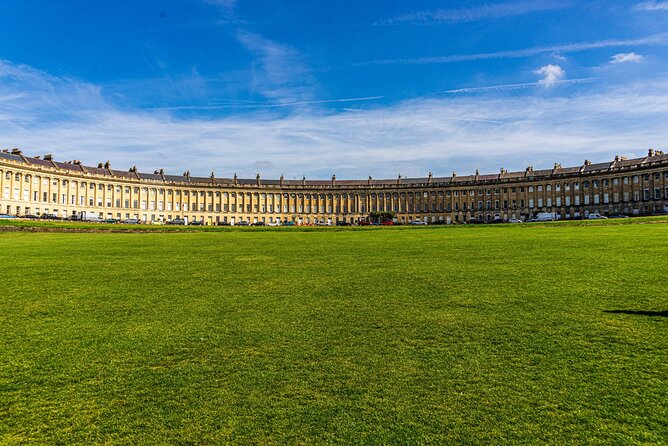
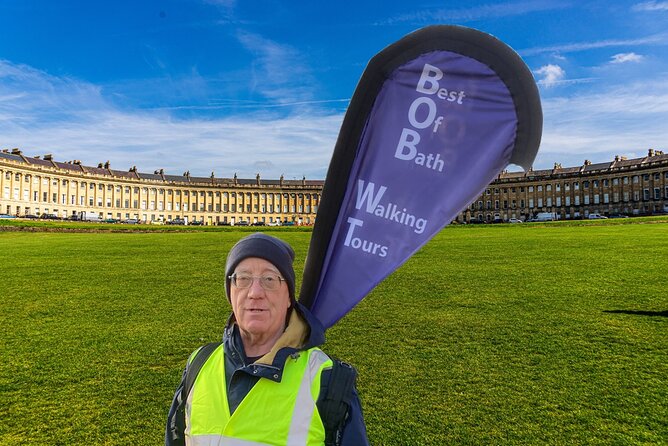
Then you come to the Royal Crescent, where Bath’s Georgian ambition peaks in a sweeping crescent of 30 terraced houses. This one is designed by John Wood the Younger, built between 1767 and 1774, and it is also Grade I listed. Standing near it, you start to understand the Georgian idea of “planned sightlines.” You are not just looking at houses, you are walking into a designed backdrop meant for viewing and being viewed.
The tour also includes a stop for No. 1 Royal Crescent, where entry is not included. If you want to go inside, you will need to plan that ticket separately. If you do not, you still get a lot from the exterior views and Bob’s explanations of how the crescent works visually.
Pulteney Bridge and Bath Guildhall Market for the Real Bath Feeling
After the big-name Georgian landmarks, the walk gives you two “living Bath” stops that make the day feel less like a museum circuit.
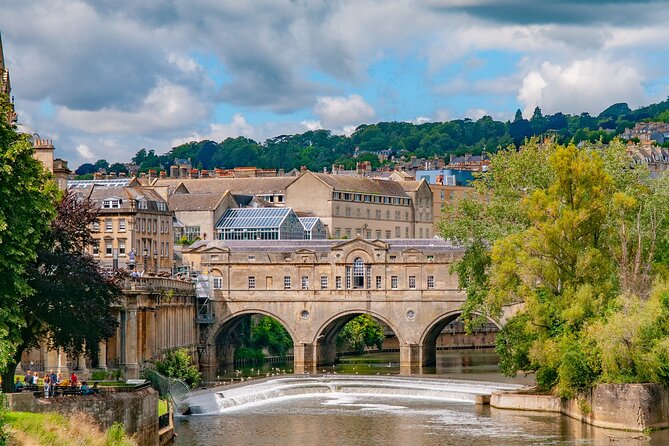
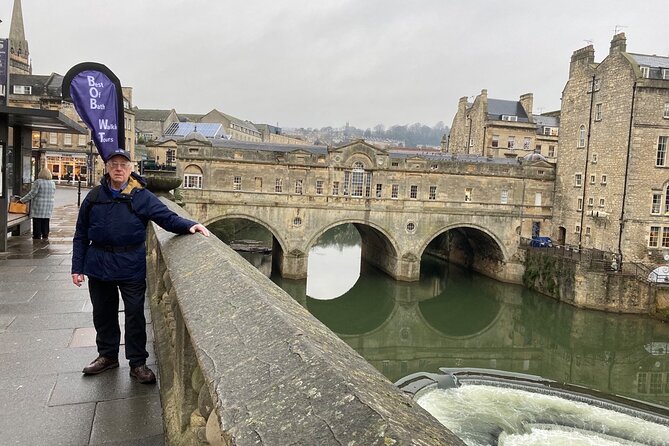
First is Pulteney Bridge, completed by 1774. It connects the city with the Pulteney family land that they wanted to develop, and it is designed by Robert Adam in a Palladian style. Here’s what makes it unusual: shops are built across its full span on both sides. Instead of being only a crossing, it behaves like a street you walk over, which is why it feels different from typical bridges.
Then comes Bath Guildhall Market, an indoor market space housed in a beautiful building. The market has been established since 1284, which is a reminder that Bath’s commercial life did not wait for the Romans or the Georgians to begin. This is also where you get a break from the constant sight-seeing. Even if you only pop in for a few minutes, it gives your brain a rest and gives you a more everyday angle on the city.
The tour returns you to the meeting point at Abbey Churchyard, so you end where you started, with time to talk through anything you want to understand better.
How the Timing and Pace Feel (2 to 3 Hours)

This is a 2 to 3 hour walking tour, and in practice it feels like a half-day commitment that still leaves room for lunch and extra browsing. The tour runs from 1:00 pm and ends back at Abbey Churchyard.
Group size is capped at 15 travelers, which helps a lot on a walking route like this. You can hear your guide without shouting, and if you ask a question, Bob can actually answer it without turning into a one-way lecture.
Physical fitness is listed as moderate, and you will be walking continuously most of the time. If you need frequent seating breaks, plan for that early, because the flow of the tour is designed to keep you moving.
Weather is a factor too. The experience requires good weather, so on rainy days you may get an alternate date or a full refund.
Tickets and Value: What You Pay for at $27.73
The price is $27.73 per person, and the value is in how the tour “sorts” Bath for you. You pay for a guided story that ties multiple big-ticket sights together, so you do not waste time bouncing between places that are unrelated.
What is included is mostly the orientation and the exterior sightseeing. Many stops list admission as free, including key outdoor views and Georgian streetscapes.
What is not included are entries for the big indoor attractions along the way, such as:
- the Roman Baths
- the Royal Mineral Water Hospital
- the Assembly Rooms
- No. 1 Royal Crescent
That structure can be a win. You can choose to spend money where it matters most to you. If you love museum-style exhibits, you can budget for Roman Baths and the Royal Crescent interior. If you mainly want architecture and street-level storytelling, you can keep your ticket costs lower and still get a full tour experience.
Also, you get a mobile ticket and confirmation at booking time. That reduces friction when you are traveling.
Who This Tour Is Best For
This tour is especially good if you:
- want a guided walk that explains Bath’s Georgian design without drowning you in details
- enjoy architecture but also want the human angle, like why buildings were built the way they were
- like small group experiences where your questions get answered
It is also a smart choice if you are traveling solo or as a couple and you want a plan that avoids getting lost.
If you are the type who wants long indoor stays at every major site, you might find the exterior-forward pace a little limiting. In that case, pair this tour with a return visit to the one or two places you care about most.
Should You Book Best of Bath Georgian Tour?
Yes, I think you should book it if you want the highest payoff for a short time in Bath. You get a tight route through the Georgian icons, and Bob’s delivery is the kind that makes architecture feel personal. For most people, the $27.73 price tag makes sense because you are paying for guidance that saves you time and helps you understand what you are seeing.
Before you book, decide how many paid entries you want. If you plan to do Roman Baths and one or two indoor stops, you’ll feel like you turned the day into a mini program. If you prefer to keep it lean, you can still enjoy the walk and the key sights from the outside.
If your goal is to come away with a clearer mental map of Bath, plus real stories you can repeat later, this is a strong choice.
Recently reviewed around Bath
- Bath: Local Pubs & Historic Sights Walking Tour (3h)★ 4.9 · 29 reviews
- Full-Day Stonehenge and Bath Tour★ 4.4 · 39 reviews
- From Bath: Salisbury and the Jurassic Coast Small Group Tour★ 5.0 · 4 reviews
- From Bath: Private Tour to Serene Cotswolds with Pickup★ 5.0 · 3 reviews
- From Bath: Private Stonehenge and Salisbury Tour with Pickup★ 5.0 · 3 reviews
- From Bath: Cotswolds Private Day Tour with Pickup★ 4.9 · 17 reviews
- From Bath: Cotswolds and Oxford Full-Day Tour★ 4.7 · 172 reviews
- City of Bath: British Wine and Cheese Tasting Experience★ 4.9 · 21 reviews
Bath Day Trips, compared.
Stonehenge, Windsor Castle, and Bath from London
Read our review →
Stonehenge, Windsor Castle and Bath with Pub Lunch in Lacock
Read our review →
Stonehenge, Windsor Castle and Bath Full Day Guided Tour
Read our review →
Windsor, Stonehenge, Bath, and Roman Baths Day Trip
Read our review →

Windsor Castle, Stonehenge & Bath Full-Day Tour
Read our review →
Windsor, Stonehenge and Bath Day Trip from London Spanish
Read our review →
Browse the lists this tour appears in